
My video today that I love: Mia Mottley on Leadership, Legacy, and the Digital Age
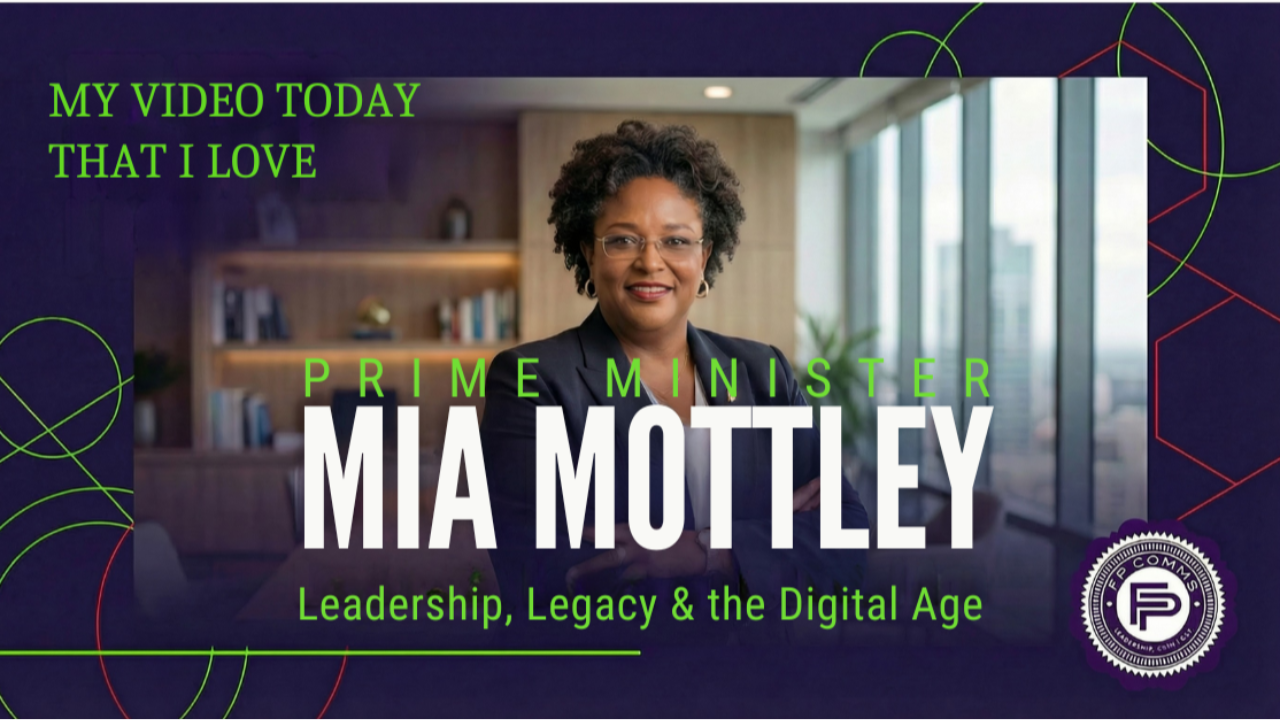
Welcome to the first instalment of ‘My Video Today That I Love,’ a new series from FP Comms dedicated to exploring the art and impact of powerful communication. In a world saturated with content, we will be highlighting videos that offer profound insights into public relations, business, and economic growth, all viewed through the lens of our core ethos: Marketing with Love.
 This series is for the forward-thinkers, the business leaders, entrepreneurs, and communicators passionate about building authentic connections and driving meaningful change. We begin with a true masterclass in leadership communication from the Prime Minister of Barbados, Mia Mottley, in her compelling conversation with Trevor Noah.
My video today that I love: Mia Mottley on Leadership, Legacy, and the Digital Age
Welcome to the first instalment of **‘My Videos Today That I Love,’** a new series from FP Comms dedicated to exploring the art and impact of powerful communication. In a world saturated with content, we will be highlighting videos that offer profound insights into public relations, business, and economic growth, all viewed through the lens of our core ethos: Marketing with Love.
This series is for the forward-thinkers the business leaders, entrepreneurs, and communicators passionate about building authentic connections and driving meaningful change. We begin with a true masterclass in leadership communication from the Prime Minister of Barbados, Mia Mottley, in her compelling conversation with Trevor Noah.
Video summary
In a captivating and wide-ranging discussion on Trevor Noah’s show, *What Now?*, Barbadian Prime Minister Mia Mottley masterfully articulates a powerful vision for leadership in the modern age. The conversation seamlessly weaves together themes of national identity, global commerce, and the urgent social challenges posed by technology. Mottley begins by celebrating the immense public relations value that global superstar Rihanna brings to Barbados. She argues that Rihanna is more than just a celebrity; she is a walking, talking embodiment of the nation’s brand, introducing Barbados to a global audience that might otherwise never have known it. Trevor Noah astutely adds that Rihanna’s story is inextricably linked to her homeland, her identity and worldview fundamentally shaped by her Barbadian upbringing.
Mottley expands on this, attributing Rihanna’s phenomenal success as a businesswoman to the core values instilled in her by Barbadian culture specifically, a deep-seated sense of fairness and social justice, encapsulated in the local phrase, “dat ain’t fair.” She presents Rihanna’s inclusive and disruptive business ventures, Fenty Beauty and Savage X Fenty, as prime examples of this principle in action. By creating products for “everybody,” regardless of skin tone, shape, or size, Rihanna has proven that a business model rooted in the simple, powerful idea that “everybody matters” is not just ethically sound but also immensely profitable. This, Mottley suggests, is a blueprint for how authentic social values can drive both business and economic growth.
The conversation then takes a crucial turn as Mottley addresses one of the most pressing issues of our time: the impact of digital devices and social media on young children. She expresses profound concern that the constant stream of short-form content is compromising the ability of young minds to engage in sustained attention, critical thinking, and deep reasoning. With poignant urgency, she describes a mobile phone as “the most powerful weapon” being placed in the hands of children before their brains are fully developed to manage it.
Mottley argues for a radical transformation in education, one that teaches children to navigate the complex risks of the digital world with the same diligence we use to teach them to cross the road safely. This new educational paradigm, she insists, must be rooted in values, essential life skills, and empathy, preparing children for a world where they are exposed to adult risks at an ever-younger age. She concludes with a powerful call for a national and international conversation to address this challenge, urging society to find a balance that protects its most vulnerable while still allowing them access to the world in their hands.
7 PR highlights from the video
1. Authentic national branding: Mottley demonstrates how a single, powerful individual like Rihanna can serve as the ultimate brand ambassador for a nation, embodying its values and telling its story on a global stage far more effectively than any traditional marketing campaign. In addition, her turn of phrase and tonality, is inviting you to learn more
2. Values-driven narrative: The concept of “dat ain’t fair” is brilliantly used to anchor the narrative. It transforms a simple cultural idiom into the foundational principle for a compelling story about inclusive economics and ethical business, making the message both relatable and profound.
3. The power of inclusive messaging: The success of Rihanna’s brands serves as a powerful case study in PR. It proves that inclusive messaging making everyone feel seen and valued—is not just a moral imperative but a potent and highly profitable business strategy that builds immense brand loyalty.
4. Bridging global and local: A key takeaway is Mottley’s skill in connecting a local, Barbadian ethos to universal, global conversations. She seamlessly links her nation’s values to international trends in business, social responsibility, and technology, elevating the relevance of her message.
5. Proactive issue leadership: By deliberately shifting the conversation to the difficult topic of children and digital devices, Mottley positions herself as a forward-thinking and socially responsible leader. This proactive approach to a critical societal issue enhances her credibility and authority
6. Framing the problem to own the solution: Mottley expertly frames the challenge of digital devices not as a purely technological problem, but as a fundamental issue of childhood development and education. This reframing is a sophisticated PR technique that allows her to lead the conversation towards solutions she advocates for.
7. A Call to action as a PR catalyst: Her closing call for a “national and international conversation” is a powerful PR tool. It is an invitation to collaborate, positioning her not as a critic who simply identifies problems, but as a constructive leader actively seeking collective solutions.
Commentary & areas of Interest
Prime Minister Mia Mottley’s impassioned comments on the need to protect young children in the digital age resonate deeply with the core mission of my book, SWIPE: Mastering the Art of Handling Trolls and Protecting Your Peace. When she describes a mobile phone as “the most powerful weapon” being handed to a child without guidance, she is articulating the very challenge that *SWIPE* was written to address. Her call for an educational transformation one that equips children with the values, skills, and empathy to navigate online risks is a high-level validation of the book’s foundational principles.
The digital world exposes everyone, especially the young, to unprecedented levels of scrutiny, comparison, and potential hostility. Mottley’s concern for their compromised ability to think critically is directly linked to the modern scourge of misinformation and online manipulation. SWIPE provides the practical toolkit for the very skills she advocates for: the ability to discern, to disengage from negativity, and to build the mental and emotional resilience required to protect one’s peace online. Her powerful intervention serves as a reminder that this is not just a parental issue, but a societal one that demands our full attention. We must arm our children not just with devices, but with the wisdom to use them without losing themselves.
PR with Purpose, Marketing with Love
